
Cultured Buttermilk in a Mason Jar
I have an exciting new Kitchen Tip for you. You might already know about my affinity for buttermilk. I use it regularly and often. Here’s a comprehensive list of my recipes that feature buttermilk:
English Muffin Bread with Honey Butter
Apple Gingerbread Upside Down Cake
Chocolate Pumpkin Whoopie Pies

Buttermilk adds something magical to many recipes – sometimes it’s tanginess, other times it’s fluffiness, still other times it’s tenderness and moisture. It is an amazing ingredient. If you shy away from buttermilk because of the texture, the name, the taste, or the smell, don’t. Buttermilk rocks.


And, on top of all its benefits, it’s remarkably simple to culture at home, saving yourself money and a last-minute trip to the store every time a recipe calls for it. Once you have a batch, you can use it to re-culture every other batch after that and you’ll always have it on hand. If you don’t use buttermilk as often as I do, this recipe is easily adjusted to make much smaller batches.
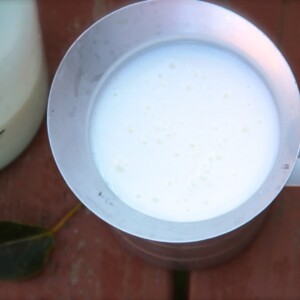
Cultured Buttermilk in a Mason Jar
Equipment
- 1 half-gallon mason jar with tightly fitting lid
Ingredients
- 8 cups 1% milk 1/2 gallon
- ½ cup store-bought cultured buttermilk
Instructions
- Into your clean half-gallon Mason jar, pour the buttermilk. Then, pour the 1% milk over top. Seal jar with lid and shake vigorously for one minute.
- Place jar on kitchen counter out of direct sunlight for 12-24 hours until thickened. When thickened, refrigerate. Your buttermilk is ready. Use within two weeks, reserving the last 1/2 cup to re-culture another batch. And another. And another.

Since I haven’t seen non-dairy buttermilk yet, can the starter be a plant-based ‘milk’ (like almond or coconut) soured with vinegar (the way my mom taught me)?
Dianne,
That is a great question! I have read that you can sour soy milk with lemon or vinegar, but I don’t know about almond or coconut. Here is a link to a conversation about a soy buttermilk that I found helpful: http://www.seriouseats.com/talk/2010/02/non-dairy-buttermilk-substitute-in-baking.html
Dianne,
That is a great question! I have read that you can sour soy or rice milk with lemon or vinegar for buttermilk substitute (here’s a helpful link: http://www.seriouseats.com/talk/2010/02/non-dairy-buttermilk-substitute-in-baking.html), but I’m not sure about almond or coconut. As to whether it would work as a starter in this recipe, I honestly couldn’t say. My advice would be to try a very small amount (1c of non-dairy milk and 1 tablespoon non-dairy buttermilk substitute) and try to culture it in a small Mason jar and see if it thickens up. If you try this, I would love to hear how it turns out. Thanks again for the question.
If only there were a way to make buttermilk without having to use buttermilk as a base. I miss the stuff here in Italy!
I agree! 🙂
What a great tip Thanks
@Alaska from Scratch If you are really lucky you need nothing else but raw milk. That’s how my grandma used to make it for us when we were little. I tried it too and it does work but it is easier to buy it, I have to admit. You just let the milk sit in a shallow bowl covered to protect it from dust in room temperature for a while. The needed bakteria is in the air and will make their way into the milk eventually. It tastes delicious cold with cinnamon and sugar. That is how we eat it here in Germany. All other ways such as adding vinegar or lemon are good for souring milk but it does not taste the same, I think.
And thank you for your article, I finally understand what the difference is between buttermilk and cultured buttermilk as for me buttermilk was always the residuals when making butter and i never understood the hype of buttermilk in Amerika as I think this tastes awful.
In the list of ingredients you say “1/2 store-bought cultured buttermilk”–this means 1/2 what? aCup? Carton?
@Tom Thank you for your question. That is 1/2 cup cultured buttermilk. You can find a list of the recipe abbreviations on the FAQ page for future reference! Hope this helps. http://alaskascratch.wpengine.com/faq/
I need to be able to make buttermilk without using buttermilk. There is no buttermilk withing 100 miles from me……
wcbar Milk soured with either vinegar or lemon juice makes a nice buttermilk substitute. Another option is to make my homemade butter recipe and reserve the buttermilk (http://alaskascratch.wpengine.com/2013/05/03/homemade-butter/).
Thanks for the recipe! Can I use whole milk?
@Tom Look closely. There’s a “c” after the “1/2”.
@Memoria James You can send away for starter kits. Or, get raw milk to start the culture.